BoldVoice - Accent Training
- 4.7
- Rating
- 1.00M
- Installs
- Free
- Price

 Analysis by App-foxy
I found BoldVoice most useful when I treated it as a focused speaking coach rather than a complete English course. Its purpose is narrow and clear: helping learners work on English pronunciation and an American accent through guided practice. That focus makes the app easier to understand than a broad language-learning platform, but it also means the value depends heavily on whether pronunciation is your main problem.
In my experience, the best reason to try it is that it turns a vague goal such as “sound more natural” into something I can actually practice. Instead of only memorizing vocabulary or completing grammar exercises, I have to pay attention to how sounds are formed, how words connect, and how a sentence comes out when spoken aloud. That shift matters for learners who already know plenty of English but still feel hesitant in conversations.
BoldVoice is a free education app from BoldVoice, rated for Everyone. It has reached over 500 thousand installs and holds a 4.5 average from around 12 thousand ratings, which suggests that its pronunciation-first approach has found a sizeable audience. The app was released on June 16, 2021, and version 4.6.7 requires Android 8.0 or later. Optional purchases range from $9.99 to $199.99 per item, so I would explore the free experience carefully before committing to anything paid.
You May Also Like

 Blood Strike: 2.5 Anniversary
Blood Strike’s Loadouts Turn Every Drop Into a Tactical Gamble
A close look at Blood Strike’s custom loadouts: how fast access to signature weapons reshapes its battle royale rhythm, rewards preparation, and narrows the gap between fights.

 Pandora - Music & Podcasts
Pandora’s Music Is Easy to Start, but Harder to Recover
Pandora’s strength is its low-effort path from a seed to a station. Its weak spot is how much confidence it asks you to place in connection, setup, and quiet recovery.

 8 Ball Pool
 Is Built on Rivalries, Rematches, and Routine
A close look at the rivalries, rematches, shared routines, and unanswered safety questions that turn a quick pool match into a persistent mobile community.

 Samsung Music
’s Quiet Strength Is Playing What You Already Own
Its reach comes less from spectacle than from dependable access to a personal library. That simplicity is both the app’s strongest retention engine and its ceiling.

 AccuWeather: Weather Radar
AccuWeather Review: A Quick, Clear Forecast for Everyday Decisions
For everyday plans, the best forecast is the one you can understand quickly. AccuWeather makes rain timing, radar, and local conditions easy to act on, with a few trade-offs.

 Hill Climb Racing
Why Hill Climb Racing Still Turns Crashes Into One More Run
A tiny car, a bumpy hill and one more upgrade: Hill Climb Racing keeps resurfacing because its simple chaos makes every near-miss feel personal.
More From Our News Desk



How the coaching feels in everyday use
The central experience is built around speaking, listening, and repeating rather than silently tapping through vocabulary. That makes the app feel closer to a personal pronunciation workout than to a standard flashcard tool. I found that distinction important: if I only wanted to expand my word list, another education app would probably be more efficient. If I wanted to improve the way familiar words sound when I say them, this format made more sense.
The American accent focus is also worth considering before downloading. English has many legitimate accents, and there is no universal requirement to sound American. BoldVoice is most relevant to someone who specifically wants American pronunciation for work, study, travel, media comprehension, or confidence in conversations with American speakers. Learners targeting British, Australian, Irish, or another regional variety should not expect this app to match that goal.
I would describe the lessons as best suited to short, deliberate sessions. Pronunciation work becomes tiring when I rush it, especially if I repeat a sentence without listening closely to the difference between my version and the model. A useful routine is to choose one troublesome sound or rhythm pattern, practice it slowly, then use it in a complete sentence. That approach is more productive than trying to finish as many exercises as possible.
One subtle strength is that pronunciation practice exposes problems that ordinary reading often hides. I might recognize a word immediately on screen while still saying it with the wrong stress or vowel. A speaking-centered app brings that gap into view. It is particularly helpful for learners who can follow written English comfortably but are frequently asked to repeat themselves in conversation.
Why the microphone changes the learning habit
Speaking into a phone can feel awkward at first, especially in a shared room or on public transport. That awkwardness is not a flaw in the lesson itself, but it affects whether I use the app consistently. I got more from it when I practiced somewhere quiet and treated each attempt as a private rehearsal rather than a performance.
The microphone also changes how I judge progress. A completed exercise is not the same as a clearer pronunciation habit. I had to resist the temptation to chase a quick pass and instead listen for whether the sound remained understandable when I spoke at a normal pace. This is one of the app’s more important trade-offs: it encourages active speaking, but active speaking requires more attention than tapping answers.
For a busy learner, a practical workflow is to use a short session before a real speaking task. Someone preparing for an interview could rehearse a few common answers, concentrating on word stress and sentence rhythm. A student could practice a presentation opening before class. A traveler could use it to become more comfortable with phrases they expect to say repeatedly. The app does not replace that real-world conversation, but it can make the first attempt feel less improvised.
What happens when the connection is not reliable
Connectivity shapes the experience more than it might seem from the app’s simple purpose. Lessons involving streamed explanations, audio, or interactive speaking checks can be less convenient when the network is weak. I would not plan an important practice session around a train journey, crowded venue, or building with unreliable reception unless I had already opened the material and confirmed that the particular activity was ready to use.
This matters because pronunciation practice depends on continuity. If an exercise pauses while audio loads, or if a response takes too long to process, the learner’s attention moves away from the sound itself. A small interruption can turn a focused repetition drill into a frustrating technical pause. When the connection is stable, the experience feels much more natural; when it is not, the app becomes harder to use spontaneously.
I also recommend launching the app before leaving home if I know I will practice elsewhere. That gives me a chance to see whether the selected lesson opens normally and whether the speaking activity responds as expected. It is a simple habit, but it prevents the common mistake of discovering a connectivity problem only after setting aside time to study.
For people who want a completely dependable offline routine, this is an important point of caution. A downloaded language book, saved pronunciation notes, or locally stored audio may be more predictable in places without service. BoldVoice is more appealing when I can give it a stable connection and a quiet moment, rather than when I need a guaranteed coach in every location.
Using it on a phone without making practice awkward
A smartphone is a natural format for this kind of coaching because it is always nearby, but the small screen affects the way I practice. I prefer holding the phone where I can see the lesson without covering the microphone, then speaking at a normal volume instead of leaning too close. That setup reduces the chance that I change my voice simply because the device feels too near.
Public spaces are another practical limitation. Reading silently on a bus is easy; repeating English sentences aloud is not always socially comfortable. I would use BoldVoice at home, in a private office, or during a quiet break rather than assume every spare minute is suitable. If privacy is limited, listening and shadowing quietly may be possible, but that is not equivalent to producing a clear, full-volume response.
Headphones can help when the surrounding environment is noisy, particularly during listening-focused parts of a lesson. They do not solve every problem: I still need the phone’s microphone to hear my speech clearly, and background noise can affect how comfortable the exercise feels. A quiet room remains more useful than expensive accessories.
Battery and mobile data are also part of the decision, even though they are easy to overlook. Audio and interactive practice can be inconvenient when I am trying to preserve a low battery or avoid using cellular data. I would normally use a home or workplace connection for longer sessions and reserve mobile practice for moments when I already know the lesson behaves well on that network.
Recovering after interruptions and imperfect attempts
Pronunciation learning is full of imperfect attempts, and that is normal. The more useful question is whether I can return to the exercise without losing the thread. If the app closes, the connection drops, or I simply stop halfway through a lesson, I prefer to reopen the same activity and repeat the difficult part rather than restart my entire study plan.
A good recovery method is to keep a tiny personal list of words or phrases that repeatedly cause trouble. I can write down the phrase after a session and say it later without the app, then return to the lesson when I have a stable connection. This creates a bridge between guided practice and spontaneous speech. It also prevents the app from becoming the only place where I use the new pronunciation.
Another useful habit is recording a private before-and-after sample outside the lesson, using the phone’s ordinary recording tool if I want a longer-term comparison. I would not treat one recording as scientific proof of improvement, but hearing the same sentence after several weeks can reveal changes that are hard to notice from day to day. The key is to keep the sentence and speaking speed similar each time.
There is also a psychological recovery step. If an automated check does not recognize an attempt, I should not immediately assume that my English is poor. Microphone position, room noise, speed, and a small pronunciation difference can all affect a response. I would slow down, move somewhere quieter, and repeat the phrase once or twice. If the same problem continues, I would use the lesson as guidance and then ask a human listener for confirmation when possible.
Making practice kinder to your data plan
Because the app is designed around audio and spoken interaction, I would be conscious of when and where I use it. Home Wi-Fi is the obvious choice for regular practice, especially if I plan to work through several activities in one sitting. On cellular data, short sessions are more sensible than leaving the app open while browsing or repeating exercises without a clear goal.
I also avoid switching rapidly between lessons when my connection is poor. Repeated loading is frustrating and may use more data than a planned session. Choosing one target, completing it carefully, and closing the app afterward is both a better learning workflow and a more responsible way to use a limited connection.
People with strict data limits should test the app during a Wi-Fi session before building it into a daily routine. The important issue is not only how much data a single interaction uses, but whether the learner’s habits lead to many audio and speaking activities throughout the day. A short, scheduled practice block is easier to control than constant casual opening and closing.
The free price lowers the barrier to trying that routine, but the in-app purchase range means I would pay attention before upgrading. I would first decide whether the coaching style fits my learning habits, whether I can practice aloud comfortably, and whether the network conditions where I live are suitable. Paying for more material will not fix a routine that is inconvenient or a goal that does not match American pronunciation.
Who will benefit most, and who should choose something else
I think BoldVoice is a strong match for an intermediate English learner who already understands everyday vocabulary but wants clearer spoken delivery. It can also suit professionals preparing for conversations, presentations, or interviews, provided they are willing to speak aloud and repeat phrases with patience. Learners who feel that their accent causes unnecessary hesitation may appreciate the narrow focus more than a general course would offer.
It is less suitable for a complete beginner seeking a full path through grammar, reading, writing, vocabulary, and conversation. Pronunciation is important, but it is only one part of language ability. Someone who cannot yet form basic sentences may need a broader course first, then use this kind of coaching once pronunciation becomes the main obstacle.
I would also steer away from it if the goal is simply to imitate a particular non-American accent. The app’s identity is tied to American accent coaching, so choosing it for a different regional target would create avoidable frustration. Likewise, a learner who refuses to practice aloud will miss the point of the experience, even if they enjoy watching explanations.
Compared with flashcard apps, BoldVoice gives pronunciation a much more central role, but it is not as efficient for memorizing large amounts of vocabulary. Compared with a live tutor, it is more convenient and easier to use for repeated drills, but it cannot fully replace a person who can respond to unusual questions, understand personal speech patterns, and explain a communication problem in context. Compared with free videos, it offers a more guided habit, while videos may provide broader accents and topics.
That comparison helped me place the app correctly. I would use BoldVoice as a pronunciation layer alongside conversation practice, reading, and listening to real speakers. I would not expect it to be my only English resource. Its greatest value comes when I take a coached phrase into an actual conversation and notice whether it feels easier to say and easier for other people to understand.
My connectivity verdict
BoldVoice works best when three conditions come together: a stable connection, a quiet place, and enough privacy to speak naturally. Under those conditions, the phone becomes a practical accent coach that I can use in a short, focused routine. The experience is less convincing when I am offline, surrounded by noise, worried about data use, or trying to squeeze in silent study on a crowded commute.
I like the app because it addresses a specific frustration that broad language platforms often treat as a side issue: knowing what to say but not feeling confident about how to say it. The American pronunciation focus, speaking-centered exercises, and manageable mobile format give it a clear purpose. The main friction is equally clear: it asks for active participation, reliable access, and a willingness to hear and adjust my own voice.
My recommendation is to start with a small routine rather than purchase anything immediately. Use it during a reliable Wi-Fi session, practice one pronunciation target at a time, and test whether you can comfortably speak into the phone several times a week. If that routine fits your life, BoldVoice is a focused tool for turning pronunciation awareness into a repeatable habit. If you need a full language curriculum, a different accent target, or guaranteed access in disconnected places, another learning option will serve you better.
FAQs for BoldVoice - Accent Training
01What is BoldVoice - Accent Training, and who is it designed for?
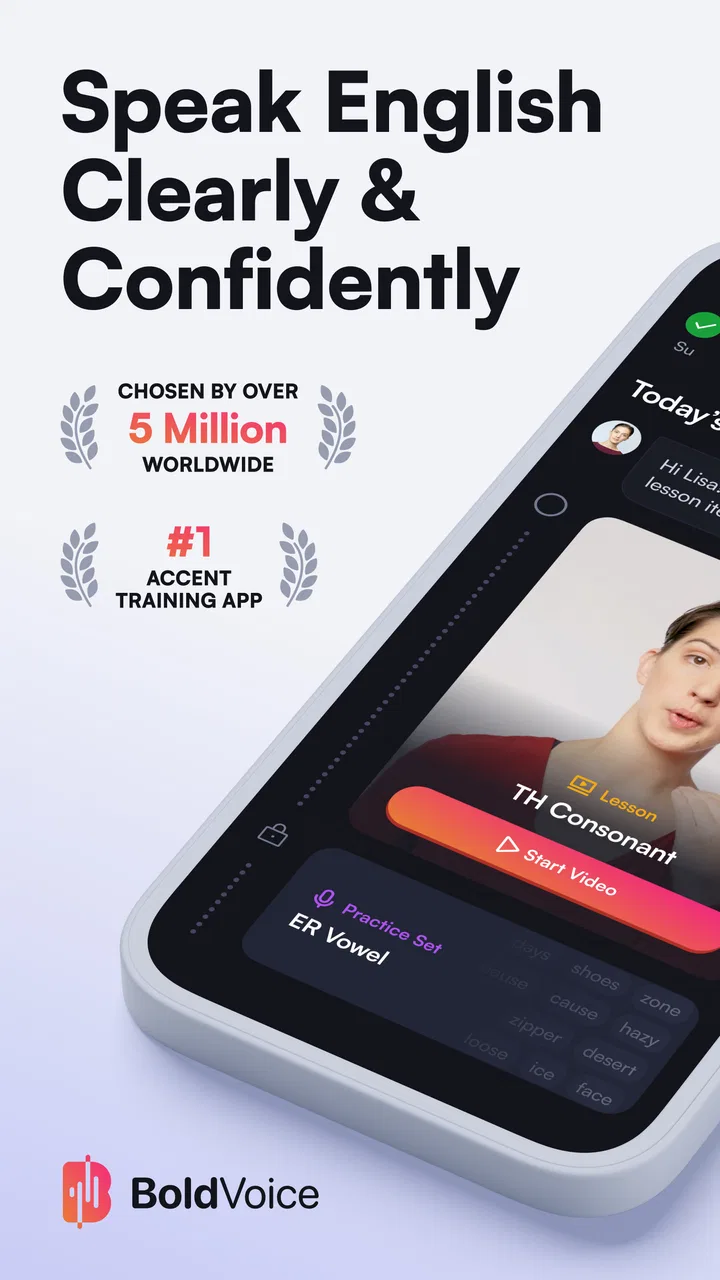
BoldVoice is a pronunciation and accent-training app designed for people who want to speak English more clearly and confidently. It uses short video lessons, guided pronunciation practice, and feedback-focused exercises to help learners improve sounds, rhythm, stress, and intonation. It can be useful for international professionals, students, immigrants, and anyone who wants to sound more natural in everyday or workplace conversations.
02How does BoldVoice help improve English pronunciation?
The app teaches pronunciation through structured lessons presented by experienced English-speaking coaches and communication experts. You typically watch an explanation, listen to examples, and then repeat words or phrases yourself. The training focuses on practical speaking habits rather than memorizing grammar rules, helping you notice difficult sounds, improve sentence stress, and develop clearer pronunciation through repeated, guided practice.
03Does BoldVoice work for beginners, or is it better for advanced English speakers?
BoldVoice can be helpful for a wide range of learners, but it is especially valuable for people who already understand basic English and want to improve how they sound when speaking. Beginners may still benefit from the pronunciation exercises, although they might need additional resources for vocabulary and grammar. The lessons are generally practical and easy to follow, with an emphasis on real communication rather than academic study.
04Is BoldVoice free to use, or does it require a subscription?
BoldVoice may allow users to explore introductory content or begin with a trial, but full access to its lesson library and training features generally depends on a paid subscription. Pricing, trial availability, billing periods, and renewal terms can vary by platform, region, or promotion. Before confirming a purchase, check the subscription screen carefully, including automatic renewal details and the cancellation policy shown in the Google Play Store or Apple App Store.
05How much time should I spend using BoldVoice to see results?
You do not necessarily need long study sessions to benefit from BoldVoice. A consistent routine of around ten to fifteen minutes per day can be more effective than practicing for a long period only once a week. Progress depends on your current pronunciation, native language, goals, and willingness to speak aloud. For stronger results, repeat challenging exercises, record yourself when possible, and use the techniques in real conversations.
Pros
- Short lessons fit easily into busy daily routines.
- Speech recognition provides immediate pronunciation feedback.
- Focuses on practical phrases used in real conversations.
- Progress tracking helps maintain motivation over time.
- Useful for learners preparing for work or social situations.
Cons
- Full access requires a paid subscription after the trial.
- Feedback may be less accurate with background noise.
- Some lessons can feel repetitive during regular practice.
- Primarily targets American English pronunciation and accents.
- Advanced learners may find the exercises too basic.

BoldVoice - Accent Training
Gallery